Table of Contents
Professional dog grooming costs between $50 and $90 per session, and most dogs need grooming every 4 to 8 weeks. That adds up to $300 to $1,080 per year -- per dog. If you have two or three dogs, you are looking at a serious recurring expense. The good news: you can handle 80% of routine grooming at home with a few basic tools and the right techniques.
This guide walks you through every step of at-home dog grooming, from daily brushing to nail trimming that does not terrify your dog. You will learn exactly what tools you need, how often to perform each task, and when it is smarter to call a professional.
Why Groom Your Dog at Home?
Beyond the obvious cost savings, at-home grooming gives you something a grooming salon never can: control. You set the pace, you choose the products, and your dog stays in a familiar environment. For dogs with anxiety, reactivity, or past bad experiences at the groomer, home grooming can make a real difference.
Regular grooming also builds your bond with your dog. The 10 to 15 minutes you spend brushing each day gives you a chance to check for lumps, bumps, hot spots, ticks, and skin irritations that might otherwise go unnoticed. A 2024 survey by the American Pet Products Association found that 67% of dog owners who groom at home caught a health issue early that might have been missed between vet visits.
You do not need a grooming table or professional dryer to get started. The essentials -- a quality slicker brush, stainless steel comb, dog-specific nail clippers, and ear cleaning solution -- will cost you about $60 to $80 total. That is roughly the price of one professional grooming session.
Brushing: The Foundation of Good Grooming
Brushing is the single most important grooming task you can do at home, and it is also the easiest. It distributes natural oils through the coat, removes loose fur before it ends up on your furniture, and prevents painful mats that can pull on the skin and cause infections.
How Often Should You Brush?
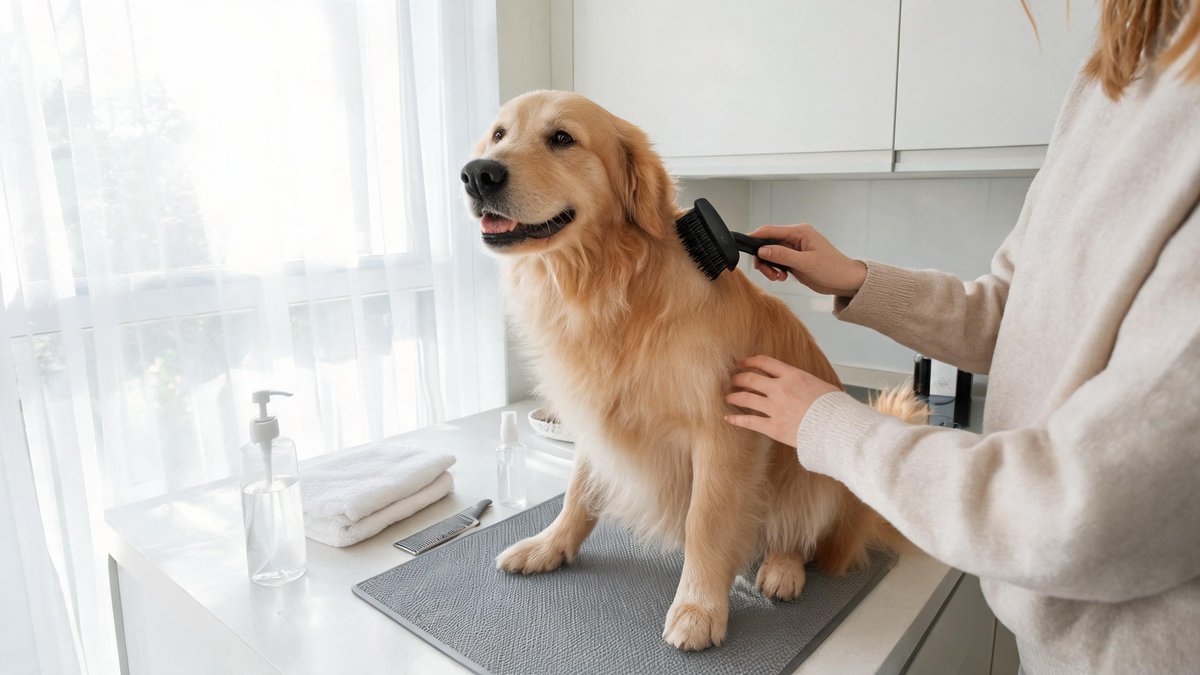
The frequency depends entirely on your dog's coat type. Short-haired breeds like Beagles, Boxers, and Dalmatians need brushing once per week with a rubber curry brush or bristle brush. Double-coated breeds like Huskies, Golden Retrievers, and German Shepherds need brushing 2 to 3 times per week with an undercoat rake and slicker brush -- daily during spring and fall shedding seasons. Long-haired breeds like Shih Tzus, Maltese, and Yorkies require daily brushing with a pin brush and metal comb to prevent mats from forming.
Curly-coated breeds like Poodles and Doodles are the highest maintenance: they need daily brushing with a slicker brush followed by line-combing with a metal comb to reach the skin. If you only brush the top layer, mats will quietly form underneath and you will not notice until they are severe.
Proper Brushing Technique
Always brush in the direction of hair growth, working section by section from the neck down to the tail. Part the coat with your free hand to expose the skin, then brush from the root outward. If you hit a mat, do not yank. Hold the mat at the base (closest to the skin), then use the tip of a metal comb to gently work it apart from the ends inward. For mats too tight to comb out, use clippers -- never scissors, which can easily cut the skin.
Finish every brushing session by running a metal comb through the coat from skin to tip. If the comb glides through without resistance, you have done the job right.
Bathing Your Dog Without the Mess
Most dogs need a bath every 4 to 8 weeks. Bathing too often strips natural oils and leads to dry, itchy skin; bathing too infrequently leads to odor, dander buildup, and skin infections. Dogs with skin conditions may need medicated baths more frequently -- follow your vet's guidance on this.
Before you start: brush your dog thoroughly. Bathing a matted dog will tighten the mats and make them nearly impossible to remove later. Gather everything you need before bringing your dog to the bath area -- dog-specific shampoo, a non-slip mat for the tub floor, several old towels, cotton balls to place in the ears (keeps water out), and a detachable shower head or large cup for rinsing.
Use lukewarm water -- if it is too hot for your inner wrist, it is too hot for your dog. Wet the coat thoroughly from neck to tail, avoiding the face for now. Apply shampoo along the spine and work it outward, massaging down to the skin. Never use human shampoo -- a dog's skin pH is 6.2 to 7.4, while human skin is 5.2 to 5.5. Human shampoo disrupts their acid mantle and leads to bacterial overgrowth.
Rinse until the water runs completely clear. Shampoo residue is the number one cause of post-bath itching. Rinse for at least twice as long as you think you need to. For the face, use a damp washcloth with diluted shampoo to gently wipe around the eyes, ears, and muzzle. Dry with towels first, then let your dog air-dry or use a blow dryer on the lowest heat setting, held at least 12 inches away.
Nail Trimming: The Part Most Owners Dread
Long nails are not just a cosmetic issue. When nails click on hard floors, they are already too long and forcing the toes to splay unnaturally with each step. Over time, this changes your dog's gait and puts stress on the joints, increasing the risk of arthritis. Long nails can also curl under and grow into the paw pad, causing pain and infection.
Most dogs need nail trims every 3 to 4 weeks. If you start when your dog is young and pair the experience with high-value treats, most dogs learn to tolerate it within a few weeks of consistent practice.
Step-by-Step Nail Trimming
You need a sharp set of guillotine-style or scissor-style clippers made for dogs. Dull clippers crush the nail instead of cutting it cleanly, which hurts even when you avoid the quick. Have styptic powder on hand -- it stops bleeding instantly if you do cut too short.
Hold the paw gently but firmly. For light-colored nails, the quick is visible as a pink triangle inside the nail. Cut at a 45-degree angle, 2 to 3 millimeters below where the pink ends. For dark nails, trim small slices off the tip at a time, checking the cut surface after each slice. When you see a small dark circle appear in the center of the cut surface, stop -- you are approaching the quick. Most dogs need 4 to 6 small slices per nail rather than one big cut.
Pro Tip: If you accidentally cut the quick, do not panic. Apply styptic powder with firm pressure for 30 seconds. The bleeding will stop quickly. Give your dog a break and a treat, then come back to finish later. Forcing through after a painful cut will create a lasting negative association.
Ear Cleaning and Dental Quick-Checks
Ear infections are one of the most common reasons for vet visits, especially in floppy-eared breeds like Cocker Spaniels, Basset Hounds, and Labradoodles. Clean your dog's ears once every 2 to 4 weeks using a vet-approved ear cleaning solution. Never use Q-tips or cotton swabs that go deeper than you can see -- they push debris further in and can rupture the eardrum.
Saturate a cotton ball with the cleaning solution, then gently wipe the visible part of the ear canal and the ear flap. Let your dog shake their head afterward -- this brings loosened debris to the surface where you can wipe it away. Healthy ears should be pale pink and odor-free. If you notice a yeasty smell, dark discharge, redness, or if your dog flinches when you touch the ear, schedule a vet visit before cleaning -- you may be dealing with an active infection that needs medication.
While you have your dog on the grooming table, do a quick mouth check. Lift the lips and look at the gums (should be bubblegum pink, not red or pale) and teeth (yellow-brown tartar at the gumline means it is time for a dental cleaning). Catching dental issues early prevents expensive extractions later.
When to Call a Professional Groomer
Home grooming covers most routine maintenance, but there are situations where a professional groomer is worth every dollar. Breeds with complex clip patterns -- Poodles in a continental cut, Schnauzers with the traditional skirt and eyebrows, Cocker Spaniels with the layered feathering -- require skill and experience to execute correctly. A bad home haircut on these breeds takes months to grow out.
You should also defer to a pro if your dog has severe matting. Removing heavy mats safely requires clippers and experience; attempting it with scissors at home leads to emergency vet visits for lacerations. If your dog shows extreme fear, aggression, or panic during grooming, a professional who is trained in low-stress handling techniques will produce better results with less trauma. Some mobile groomers even come to your home, eliminating the stress of the salon environment.
That said, a professional groomer should complement your home routine, not replace it. The dogs that do best at the groomer are the ones who are already comfortable being handled because their owners brush them, touch their paws, and check their ears regularly at home.